Do I Need a Subwoofer With Studio Monitors? Ask the Room
When a subwoofer improves studio monitoring and when it makes the bass worse, from published monitor and sub specs, crossover ranges and room limits.
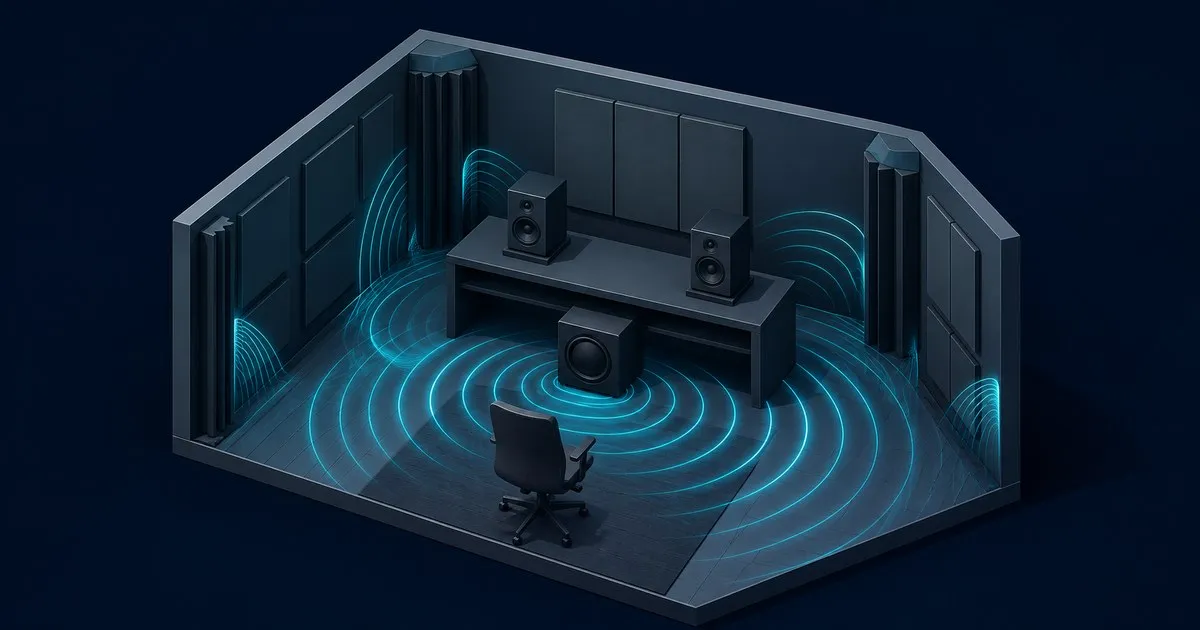
Type “do i need a subwoofer with studio monitors” into a search box and most answers come from people selling subwoofers. The published numbers give a better one. A subwoofer fills a real gap when your material has energy below the point where your monitors roll off. Whether it fills that gap or makes the low end less trustworthy is decided by the room, and in a small untreated room the second outcome is the common one.
What your monitors already reach
Every manufacturer publishes a low-frequency limit at a tolerance of its own choosing, so read the tolerance with the number.
| Monitor | Woofer | Published low-frequency limit |
|---|---|---|
| Yamaha HS5 | 5 in | 74 Hz (-3 dB), 54 Hz (-10 dB) |
| Yamaha HS7 | 6.5 in | 55 Hz (-3 dB), 43 Hz (-10 dB) |
| Yamaha HS8 | 8 in | 47 Hz (-3 dB), 38 Hz (-10 dB) |
| Genelec 8030C | 5 in | 47 Hz (-6 dB) |
| Neumann KH 120 II | 5.25 in | 44 Hz (±3 dB), 41 Hz (±6 dB) |
With A4 at 440 Hz, the equal-temperament formula puts E1, the open low string of a four-string bass, at 41.2 Hz and B0 on a five-string at 30.9 Hz. ADAM Audio’s case for a subwoofer turns on what happens below the cutoff: an acoustic instrument leaves harmonics that hint at the fundamental, a sine-based synth bass has none, so it simply goes missing. An 8 inch monitor rated to 47 Hz reaches the low E with only the bottom half-octave in doubt. A 5 inch monitor 3 dB down at 74 Hz does not, as choosing a monitor size for your room explains.
What a subwoofer actually changes
Genelec’s explanation of bass management lists what you are buying: response extended toward the lower limit of hearing, with the sub aligned in level and phase and rated flat down to 19 Hz; monitors that play louder once relieved of the lowest octave; freer monitor placement; and a bypass so you hear exactly what it adds.
The reach is real. The Genelec 7050C is rated 24 Hz to 85 Hz at -6 dB, the Neumann KH 750 DSP 18 Hz to 750 Hz within 3 dB, and the Yamaha HS8S 22 Hz to 160 Hz at -10 dB, an octave or more below every monitor in the table. What is not on the list is more bass. ADAM puts it as “lower bass, not louder bass”, and a subwoofer you can pick out as a separate source is set up wrong.
Why the room decides
A subwoofer adds energy in exactly the range where small rooms are least accurate. Standing waves set by the room’s dimensions “cause large frequency-response variations at the listening locations”, as research in the Journal of the AES puts it. The arithmetic for your own room is in room modes: how to calculate and fix bass problems: adding output alone cannot reliably fill a cancellation null. A separately placed subwoofer changes the source geometry, but its response still needs checking at the chair.
Sound On Sound’s home-studio advice puts bass trapping ahead of adding a subwoofer to an untreated room. Its 2023 subwoofer guide likewise treats a sub as useful once the other monitoring problems are addressed. Absorption and bass trapping belong in this room-treatment decision; for the separate role of scattering, see the acoustic diffusion guide.
When the answer is yes
- The material goes lower than the monitors. Sound On Sound’s subwoofer explainer describes the sub’s job as “the bottom two octaves, from 20Hz to 80Hz”. Compare the low-frequency content of your material with the model-specific limits above.
- You deliver with an LFE channel. ITU-R BS.775 specifies it as 20 Hz to 120 Hz, reproduced 10 dB above any single main channel. You cannot check a channel your speakers cannot reproduce.
- You want small monitors in a treated room. A 5 inch pair plus a sub crossed at 80 or 85 Hz reaches lower than an 8 inch pair and gains headroom, which is how Neumann and Genelec both sell their subs.
When the answer is no
- The room is small and untreated. Every source above puts bass trapping first, and the sub makes the problem it exposes louder.
- Your monitors already reach about 40 Hz. Sound On Sound’s home-studio advice questions the need to monitor lower for many music-making tasks. Check the remaining low-frequency content on suitable headphones and reference mixes before deciding whether the material requires a sub.
- You want to feel the bass. That is a preference, not a monitoring requirement, and the fastest route to mixes that come out thin everywhere else.
If you do add one
Crossover. The Genelec 7050C filters at 85 Hz, the KH 750 DSP crosses at a fixed 80 Hz with 24 dB per octave slopes, and the HS8S offers 80 to 120 Hz. Sound On Sound’s installation guide suggests 10 to 15 Hz above the monitor’s -3 dB figure and cautions against an excessively high crossover. Follow the subwoofer’s manual where its filters are fixed.
Placement. The sources disagree, usefully. Genelec’s placement guide puts the sub close to the front wall, slightly off the centre axis, for even mode excitation and the most output. The Sound On Sound writers put it as far from the listener as the monitors and away from corners, because a corner maximises boom in an untreated room. Compare candidate positions before adding more equipment. The Journal of the AES study found that multiple subwoofers can reduce seat-to-seat variation; that does not make a second sub a substitute for placement and alignment.
Phase and level. Genelec warns that “reduction of sound level may occur at the crossover frequency if the phase is not aligned”; the HS8S carries a polarity switch for exactly this. Set the level with the bypass: if switching the sub in changes the balance of the mix rather than its reach, it is too loud. As the installation guide says, “too much sub sounds impressive, but is not correct.”
So find your monitors’ -3 dB or -6 dB figure, compare it with the lowest fundamental you mix, and add a subwoofer only when the material goes lower and the room is trapped well enough to tell the truth about it.
Related across the network
- Best Filament for Beginners: What to Buy First — 3dfilamentguide.com
- Filament Density: Convert Spool Weight to Length — 3dfilamentguide.com
- How to Dry Filament: Temperatures by Material — 3dfilamentguide.com
- PLA Plus vs Regular PLA Explained: What the Plus Buys — 3dfilamentguide.com
- PLA vs PETG vs ABS: Which Filament to Use — 3dfilamentguide.com
Sources
- Genelec, Bass Management System: what a subwoofer adds to a monitoring system
- Genelec 7050C Studio Subwoofer, technical specifications (24 Hz to 85 Hz at -6 dB, 85 Hz filtering)
- Genelec, monitor and subwoofer placement guidance
- Genelec 8030C Studio Monitor, technical specifications
- Neumann KH 750 DSP subwoofer, technical data (18 Hz to 750 Hz within 3 dB, 80 Hz crossover)
- Neumann KH 120 II, technical data
- Yamaha HS Series (HS5, HS7, HS8, HS8S), published specifications
- ADAM Audio, Do I need a subwoofer for my home studio? (July 2022)
- Sound On Sound, Do You Need A Subwoofer? (April 2023)
- Sound On Sound, Q. Is it a good idea to use a subwoofer in my home studio? (February 2015)
- Sound On Sound, All You Wanted To Know About Subwoofers (April 2007)
- Sound On Sound, Choosing & Installing A Subwoofer (July 2002)
- Journal of the AES, Low-Frequency Optimization Using Multiple Subwoofers, vol. 54 no. 5 (May 2006)
- ITU-R BS.775-4, Multichannel stereophonic sound system, Annex 7 on the LFE channel
- UNSW Physics, note names, MIDI numbers and frequencies
Related

Studio Monitor Size for Your Room: 5, 7 or 8 Inch
How woofer diameter, room dimensions and listening distance interact, using published response and SPL figures for 5, 7 and 8 inch studio monitors.

Studio Monitor Setup: Placement and Room Acoustics
Why monitor placement and room treatment matter more than the speakers themselves, and how to set up a nearfield listening position correctly.

Studio Monitors vs Hi-Fi Speakers: Key Differences
This comparison explains how studio monitors and hi-fi speakers differ in voicing, amplification, directivity, connections, and intended use.